Fractional RevOps vs. In-House: Which Model Fits Your GTM Team?
The board meeting is Friday, and pipeline coverage still doesn’t match across the CRM, forecast sheet, and data warehouse. You probably won’t hire a RevOps leader before then, but you may have enough evidence that asking the CRO, sales leader, or one overworked operator to hold the system together is no longer viable.
When looking into RevOps solutions, it’s crucial to assess what kind of work the business needs right now. If the foundation is stable and the company needs a dedicated owner for recurring work, in-house RevOps may be the right choice, but if the GTM engine still needs to be designed, repaired, or expanded, fractional RevOps could be the better first move.
In this article, you’ll learn:
How fractional RevOps and in-house RevOps differ
When fractional RevOps is the better first move
When a full-time RevOps hire makes sense
How to decide whether to hire now, use fractional support, or start with a narrower project
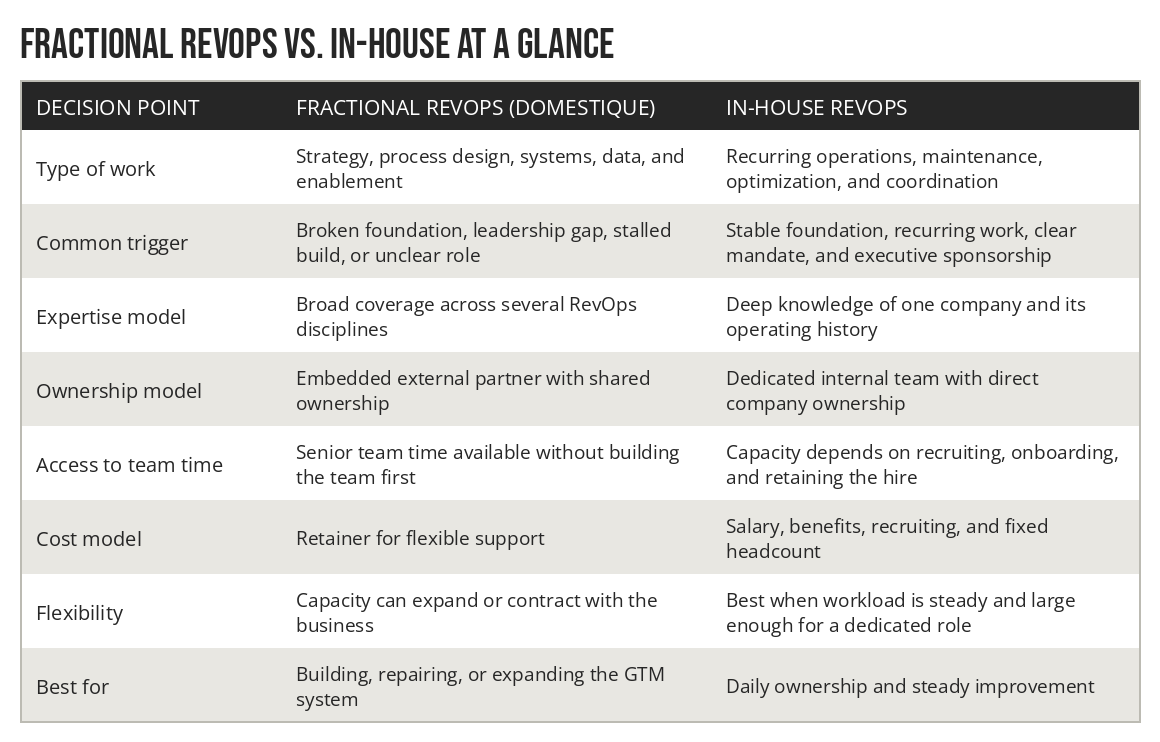
Fractional RevOps: When the System Still Needs Building
Fractional RevOps is strongest when the company has a revenue problem that no single team can solve alone. The CRM may be the visible problem, but the root cause often sits in the operating plan around it.
You may need fractional support when:
Marketing, sales, and customer success use different definitions, reports, or handoff rules.
Leadership debates the numbers instead of using them to make decisions.
A HubSpot or Salesforce build has stalled, or the setup no longer matches how the business works.
The only RevOps operator is overloaded, leaving, or acting as a single point of failure.
The company needs strategic judgment and hands-on-keyboard execution at the same time.
The business is still figuring out what its long-term RevOps role should own.
These are build problems: they require more than maintaining fields, creating dashboards, or responding to tickets. They require someone to decide how the machine should work, then make the systems support that decision.
Domestique’s approach starts with a clear sequence: Strategy → Process → Tools → Data → Enablement. The order is important. A company that buys tools before defining its process usually hinders more than it helps.
The model is embedded and practical. Domestique’s operators work across the customer journey, including marketing operations, sales operations, customer success operations, CRM, and connected systems. The positioning is simple: we build the machine, you run the plays.
For its own cost framing, Domestique compares an in-house Director of RevOps at approximately $250,000 per year fully loaded with an approximately $120,000 annual retainer. That retainer is designed to provide Director of RevOps, Director of Marketing Operations, and AI GTM Engineer support with room to flex up or down. This is specific to our engagement model, not a universal market price, but it shows the difference between buying one fixed role and gaining access to a broader senior team.
Fractional first is usually the stronger move when the company needs to build the foundation, clarify the role, or create capacity before committing to a full-time role.
Fractional support can also reduce the risk of hiring the wrong person. Once the company has a clearer operating plan, documented work plan, and a defined scope, an internal hire has an overall higher chance of success.
In-House RevOps: When Daily Ownership Is the Constraint
In-house RevOps is the better fit when the company has a foundation worth owning every day: where the core work, definitions, and plans are stable enough for one person or team to improve them over time.
A full-time hire makes sense when:
There is enough recurring shared work to keep a dedicated role busy with useful work.
The CRM, data model, reporting cadence, and handoff processes are established enough to maintain.
The business needs deep knowledge of its customers, teams, products, and operating history.
Leadership can define success and evaluate judgment, systems thinking, and communication across teams.
The role will have authority across the relevant parts of marketing, sales, customer success, finance, and systems.
The company is ready to fund a team rather than assign one person a list of CRM tasks.
An internal operator can build trust through daily contact: they learn how decisions get made, where workarounds exist, which definitions cause conflict, and which improvements the team will actually adopt. That continuity becomes valuable once the foundation is sound.
A common failure is hiring a RevOps title without giving the role a RevOps mandate. If the person can manage dashboards but can’t change lifecycle definitions, handoffs, routing, or team cadence, the company has added responsibility without authority.
In-house RevOps is strongest when the company already understands the machine it needs to run and now needs a dedicated owner to maintain and improve it.
That is also why a full-time hire can be a poor first move for a company still in diagnosis. A first hire may inherit broken definitions, unclear decision rights, and a stack that was configured without a shared operating plan. They are then judged on a system they were never empowered to redesign.
When to Hire RevOps, and Where Domestique Fits
The right time to hire RevOps is determined by the type of problem the business has, and the authority available to solve it.
We recommend starting with four questions:
Do the problems cross marketing, sales, customer success, finance, and systems?
Does the business lack one shared source of truth?
Is the constraint daily ownership, or does the foundation still need to be built?
Is leadership ready to give RevOps a cross-team mandate?
The answers usually point to one of three paths:
Hire now: The foundation is stable, the workload is recurring, and leadership can give an internal owner the authority to improve it.
Use fractional RevOps first: The foundation is broken or incomplete, the business needs senior support now, or the company is not yet clear on the right long-term role.
Start with a narrower project: The problem is isolated to one team or one defined outcome, such as a CRM audit, migration, lifecycle redesign, attribution rebuild, or routing project.
That last option matters because not every operations problem requires a full RevOps engagement. Sometimes the business needs a review. Sometimes it needs a scoped fix. Sometimes it needs an embedded team that can keep moving the roadmap forward after the initial repair.
This is where Domestique’s broader service model fits. Our service options can slot into a Build, Grow, or Scale roadmap through an audit, project-based work, or ongoing fractional support. The engagement type changes with the work, but the operating discipline remains the same.
Domestique has worked with more than 300 B2B SaaS companies. Our founders have used and honed the core Revenue Operations framework for 12 years. Those credentials matter here because the decision ultimately comes down to finding operators who can see how strategy, process, technology, data, and enablement affect one another.
If a company opts for fractional support and later decides to hire in-house, the fractional team can also help define the role, document the operating plan, support the search, and make the handoff clear. The goal is not to create dependency, but to leave a business with an engine that can be owned and maintained.
Yes. A three-question FAQ would add value if it addresses buyer objections and practical fit, rather than repeating the comparison sections. I’d place it after “When to Hire RevOps, and Where Domestique Fits” and before the conclusion.
Frequently Asked Questions
Is fractional RevOps only for companies that cannot afford a full-time hire?
No. Budget can be part of the decision, but it’s not the only reason to choose fractional RevOps. Companies also use it when they need senior expertise quickly, broader coverage than one hire can provide, or help defining the right long-term RevOps role. The value comes from accessing experienced operators without committing to one permanent role before scope is clearly defined.
Can Domestique work with an existing in-house RevOps team?
Yes. Domestique can add strategic or technical capacity when an internal team is overloaded, a major implementation has stalled, or the company needs expertise that its current team does not have. That might include supporting a CRM rebuild, improving lifecycle and handoff processes, strengthening reporting, or helping an internal leader move from reactive requests to a clear roadmap.
What happens if we eventually decide to hire RevOps in-house?
Fractional RevOps doesn’t need to be the permanent structure. It can serve as the build phase before an internal hire takes ownership. Domestique can help clarify the role, document the operating plan, support the hiring process, and create a clean handoff. The ultimate goal is to build a GTM system that the client can own, whether that ownership remains with Domestique, moves in-house, or becomes a hybrid model.
The Bottom Line
Deciding between fractional and in-house RevOps doesn’t mean choosing a permanent identity: choose the model that best matches the work in front of you. If the GTM foundation still needs to be built, repaired, or made reliable, Domestique’s fractional RevOps service is ready to help you decide what the business needs and build the system to support it.