How to Use AI for Lead Generation (Without the Hype)
Every GTM team has heard the pitch by now: plug in AI, and leads appear. In practice, most teams that try this end up with a longer list of unqualified contacts and no better sense of who is actually ready to buy.
The gap isn't the technology. It's that most AI lead gen advice skips the unglamorous part: building the data architecture that tells the AI who to target in the first place. AI in GTM & RevOps only works when it's layered on top of a clear ideal customer profile and a real signal strategy, not used as a shortcut around one.
This article breaks down what a working AI lead generation stack actually looks like, including a real example from an early-stage implementation, so you can build something that replaces manual busywork instead of adding to it.
In this article, you will find:
What "AI for lead generation" actually means once you strip out the marketing language
A real signal-based stack (HubSpot, Clay, HeyReach) used to replace a manual outbound team
How to set up account architecture so AI has something useful to work with
Where AI helps most: research, personalization, and timing
What still requires a human, and why that matters for deliverability and trust
At a Glance: AI Lead Gen Approaches Compared
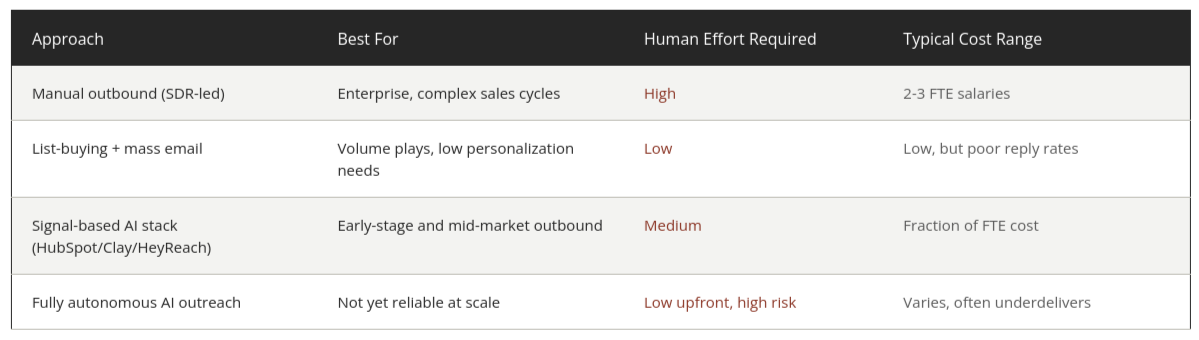
The core takeaway: the middle path, AI doing the research and routing while a human owns strategy and final judgment, is where most teams see real ROI right now.
Section 1: What AI Lead Gen Actually Means
"AI lead generation" gets used to describe everything from a chatbot on a website to a fully autonomous outbound agent. Neither of those is what's moving the needle for most B2B teams today.
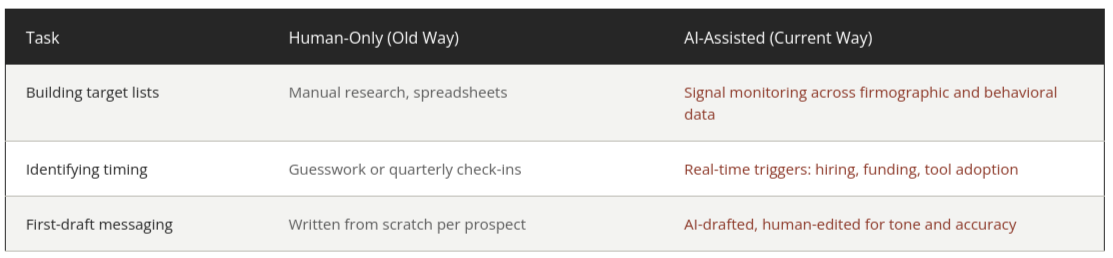
What's actually working is AI applied to three specific jobs: finding the right accounts, understanding why now is the right moment to reach them, and drafting the first version of a message a human then reviews. That's a narrower promise than "AI replaces your sales team," but it's the one that holds up.
AI's Real Job in the Funnel
Section 2: A Real Stack for Early-Stage Outbound
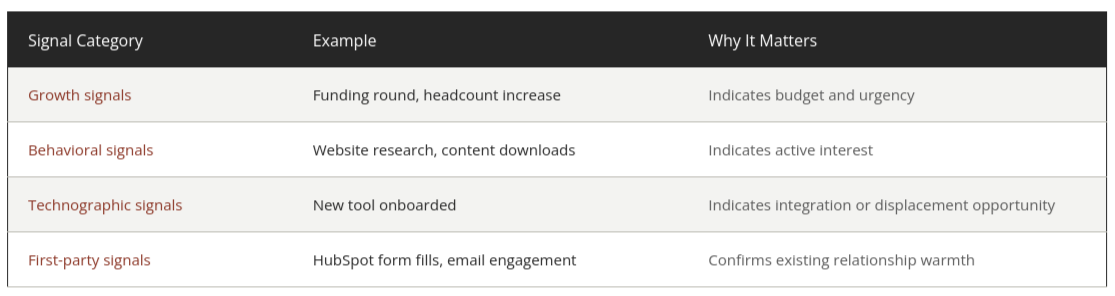
Our team at Domestique has implemented this pattern directly with early-stage clients, and it holds up well: a stack that pairs HubSpot, Clay, and HeyReach into a single signal-based outbound engine. It starts with even a rough ICP definition fed into Clay, which then monitors for signals like hiring surges, funding rounds, new tool adoption, and relevant research activity, alongside first-party signals pulled from HubSpot.
Clay filters that signal data down into a manageable account list. From there, those targets get pushed into HeyReach for 1:1 outreach, ideally sent from a founder or C-level executive rather than a generic sales inbox, since response rates tend to track with who the message appears to come from.
Why This Stack Works for Small Teams
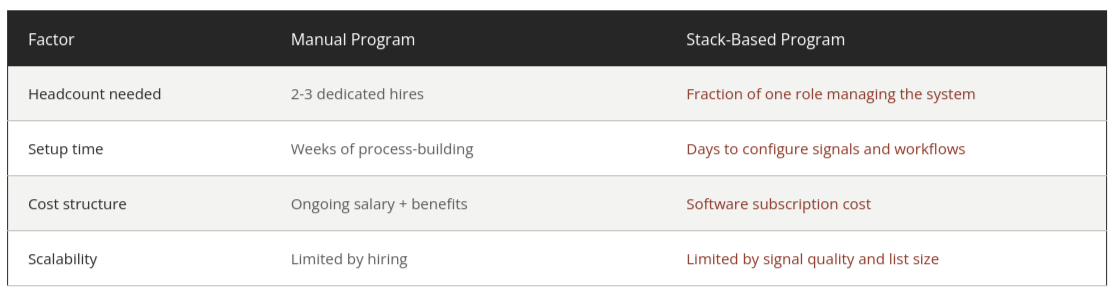
For an early-stage company, that cost difference is the whole argument. A stack like this can do the work that would have previously required two or three dedicated hires running the program manually, at a fraction of the cost.
Section 3: Building the Account Architecture First
None of this works without account architecture done right at the start. A rough ICP is enough to begin, but "rough" still means defined: company size range, industry, technographic fit, and at least one or two signals that indicate readiness (a recent raise, a leadership change, active hiring in a relevant department).
Skipping this step and pointing AI tools at an undefined audience is the single most common reason these programs underperform. The AI isn't the bottleneck. The targeting logic feeding it is.
Signal Types Worth Monitoring
Section 4: Where Human Judgment Still Matters
AI accelerates research and drafting, but sending volume without review is how deliverability and reputation get damaged fast. The teams getting the best results still have a person reviewing messaging before it goes out, adjusting tone, and making the final call on which accounts get prioritized when signals conflict.
Treat AI as the research and drafting layer, not the decision-maker. That distinction is what separates a program that scales sustainably from one that burns through a domain's sending reputation in a quarter.
FAQ
Q: How do I start using AI for lead generation if I don't have a big budget? A: Start with a rough ICP and a signal-based tool like Clay layered on top of your existing CRM. You don't need enterprise budget, you need clear targeting criteria before you turn on automation.
Q: Can AI fully replace an outbound sales team? A: Not yet, and probably not for a while. AI can replace the manual research and list-building work that used to require two or three hires, but message review and account prioritization still benefit from human judgment.
Q: What's the difference between AI lead gen and just buying a list? A: A purchased list is static and unfiltered. A signal-based AI stack continuously monitors for timing and fit, so outreach goes out when an account is actually showing signs of readiness, not just because it matches a firmographic filter.
Q: Does this approach work for later-stage or enterprise companies too? A: The same signal logic applies, but enterprise sales cycles usually need deeper account-based coordination across more stakeholders, so the AI-assisted stack becomes one part of a larger motion rather than the whole program.
Conclusion
AI in GTM & RevOps delivers real results when it's used to do specific jobs well: surfacing the right accounts, flagging the right timing, and drafting a first pass at outreach a human still reviews. The teams seeing real cost savings and pipeline gains built the targeting architecture first and let AI handle the research and routing on top of it.
If you're evaluating where your own GTM motion stands before layering in AI, that's exactly the kind of gap a maturity assessment is built to surface.
What a Real GTM Assessment Actually Tells You (And Why Most Companies Skip It)
Sources:
Clay. "Custom Signals." Clay.com, 2026. https://www.clay.com/signals
RevPartners. "What is Clay Data Enrichment and How Should You Use It?" RevPartners Blog, 2025. https://blog.revpartners.io/en/revops-articles/what-is-clay-data-enrichment-and-how-should-you-use-it
Domestique. Internal client implementation data, early-stage outbound engagements, 2026.