Revenue Operations Team Structure: How to Staff RevOps
You hired one RevOps person to fix everything, and now you're wondering why the roadmap looks like a ticket queue instead of a plan. This is the most common staffing mistake in revenue operations: writing one job description that covers strategy, system design, and hands-on build, then expecting one person to do all three well.
This happens because RevOps was built to solve a silo problem. Marketing ops, sales ops, and CS ops each owned a slice of the customer journey, so companies merged them into a single function. That solved the silo problem, but it created a new one: a job description no single hire can actually hold.
This article breaks down revenue operations team structure using a decision-altitude model instead of the old functional split, so you can see exactly which seat is unowned on your team and which one to fill first.
In this article, you will find:
Why generalist RevOps hires stall out at a fixed ceiling
The shift from structuring by function to structuring by decision altitude
The three roles that make up a modern RevOps team
How to sequence hiring by operating stage
Benchmarks to request from your own team before you finalize headcount
Revenue Operations Team Structure at a GlanceSection 1: Why the Generalist RevOps Hire Breaks
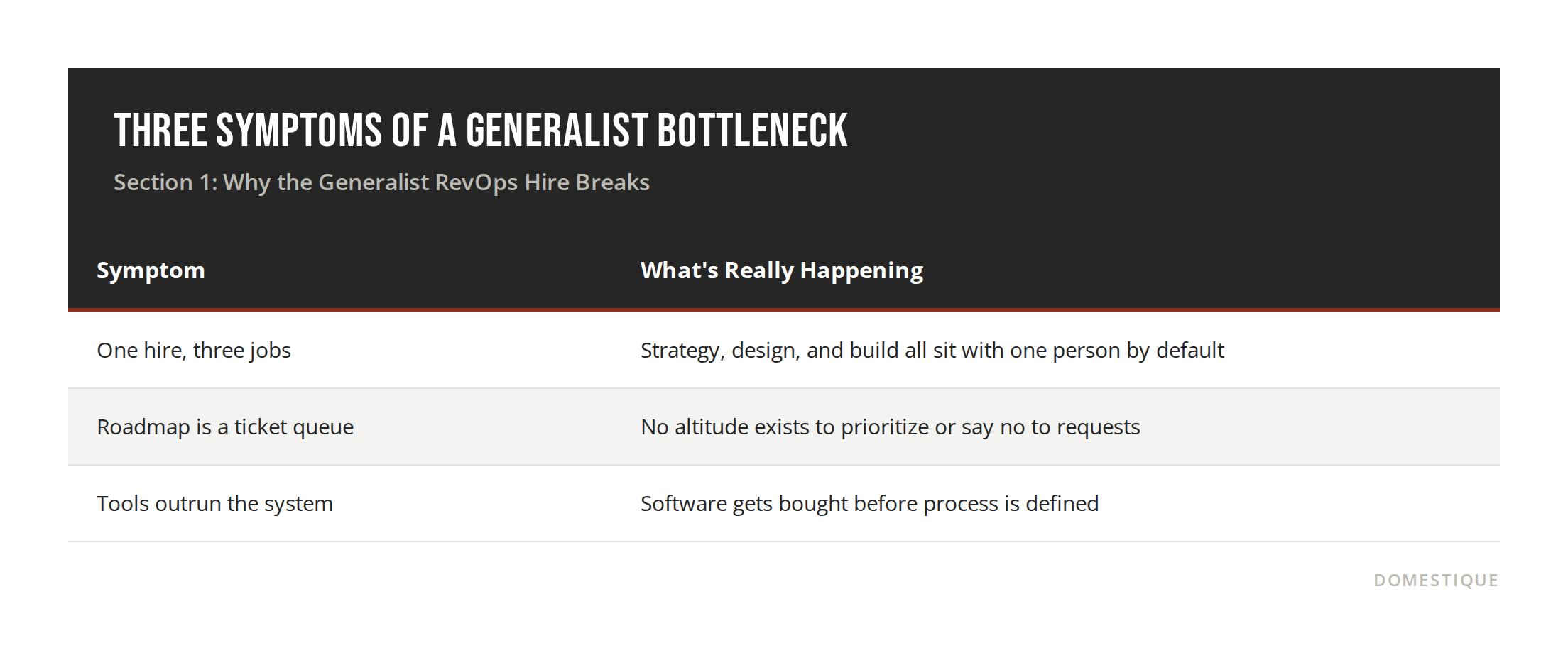
A single RevOps hire almost always defaults to whichever part of the job they're naturally best at, whether that's strategy, system design, or hands-on build. The other two responsibilities don't disappear. They just quietly go undone, sometimes for a year or more, until someone notices the data is wrong or the roadmap has no real prioritization behind it.
The generalist model isn't a hiring mistake so much as a structural one. Requests arrive from every team at once with no altitude from which to sequence or decline them, so the loudest requester ends up setting the priority. Tools frequently get purchased before the process exists to support them, which is one of the most common ways GTM spend gets wasted.
Section 2: From Function to Altitude
The first RevOps split divided work by whose team you served: marketing ops, sales ops, CS ops, GTM systems. Merging those into one RevOps function solved the silo problem because the customer never respected those internal lines in the first place.
The next split isn't a return to those silos. It divides the work by the kind of decision being made rather than which department it serves. That distinction matters because a company can have plenty of RevOps headcount and still have an unowned altitude, usually the architecture layer that sits between strategy and execution.
Section 3: The Three Roles
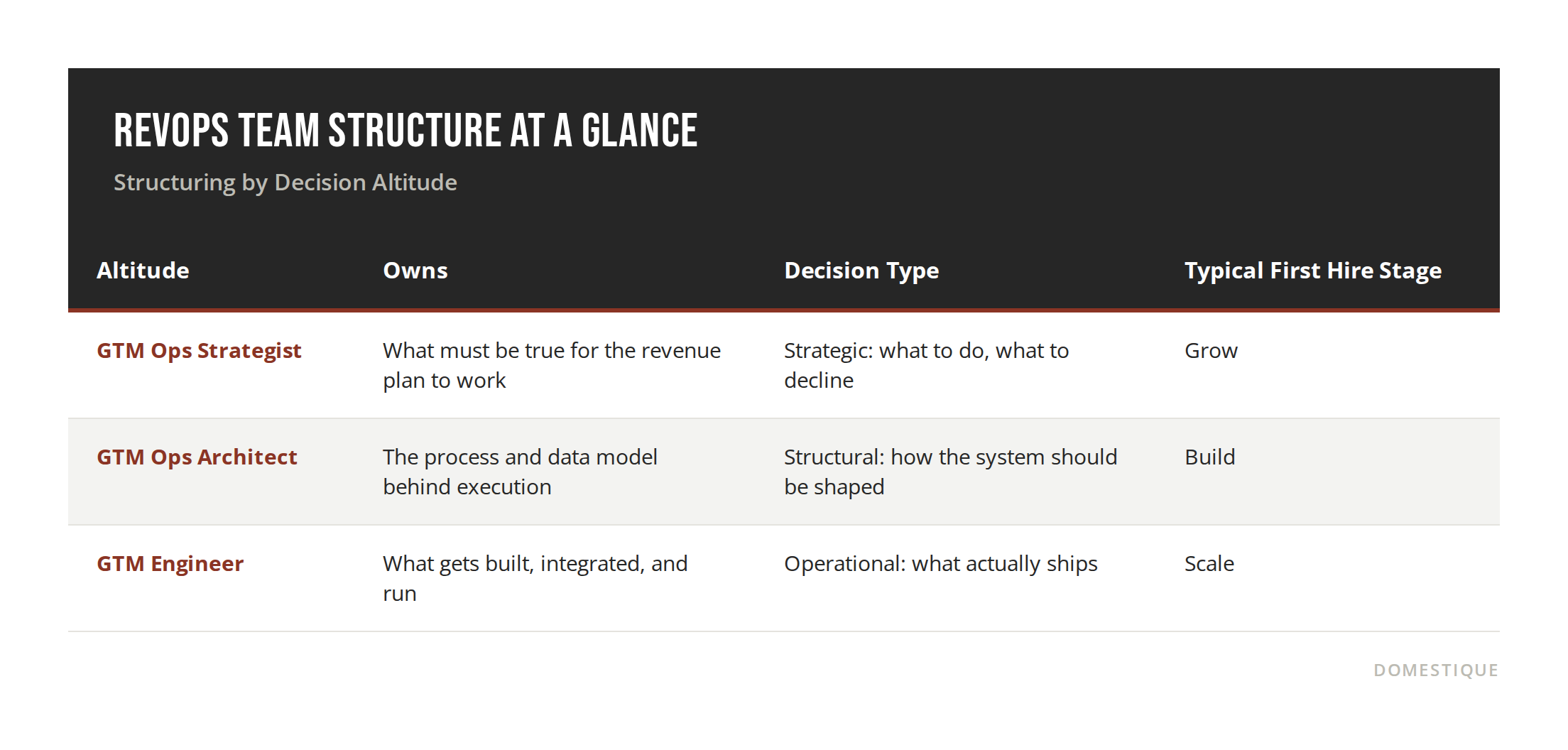
GTM Ops Strategist owns what must be true for the revenue plan to work and decides what not to do. This role answers to strategic priorities, not to whichever team submitted the most recent request.
GTM Ops Architect owns the process and data model behind execution, designing how the system should be shaped before any tool gets selected. This is the altitude most teams skip, and it's usually the reason a rebuild happens every twelve to eighteen months.
GTM Engineer owns what actually gets built, integrated, and instrumented inside the architecture already decided. This role ships quickly precisely because the shape of the system was settled before the sprint started.
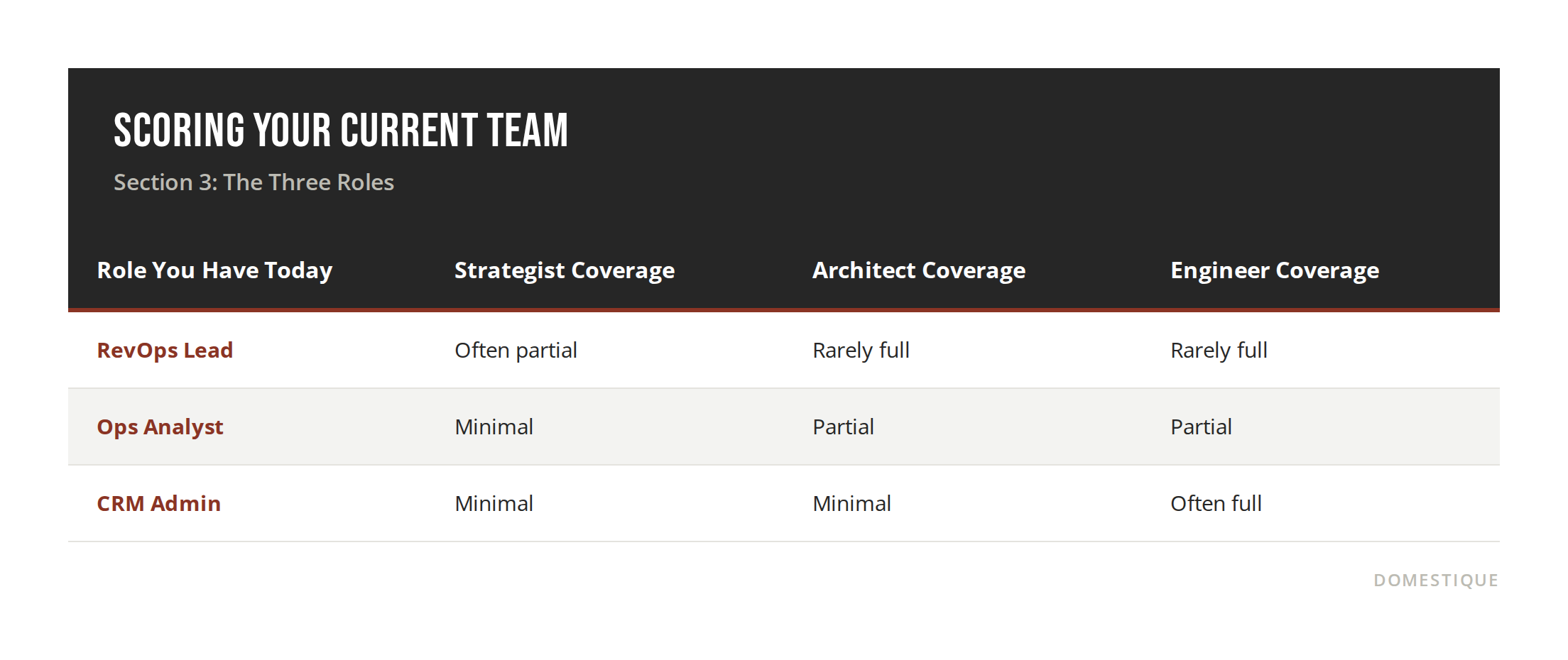
If no one on your team scores well in the Architect column, that's the seat to fill before adding more build capacity.
Section 4: Sequencing the Hire to Your Stage
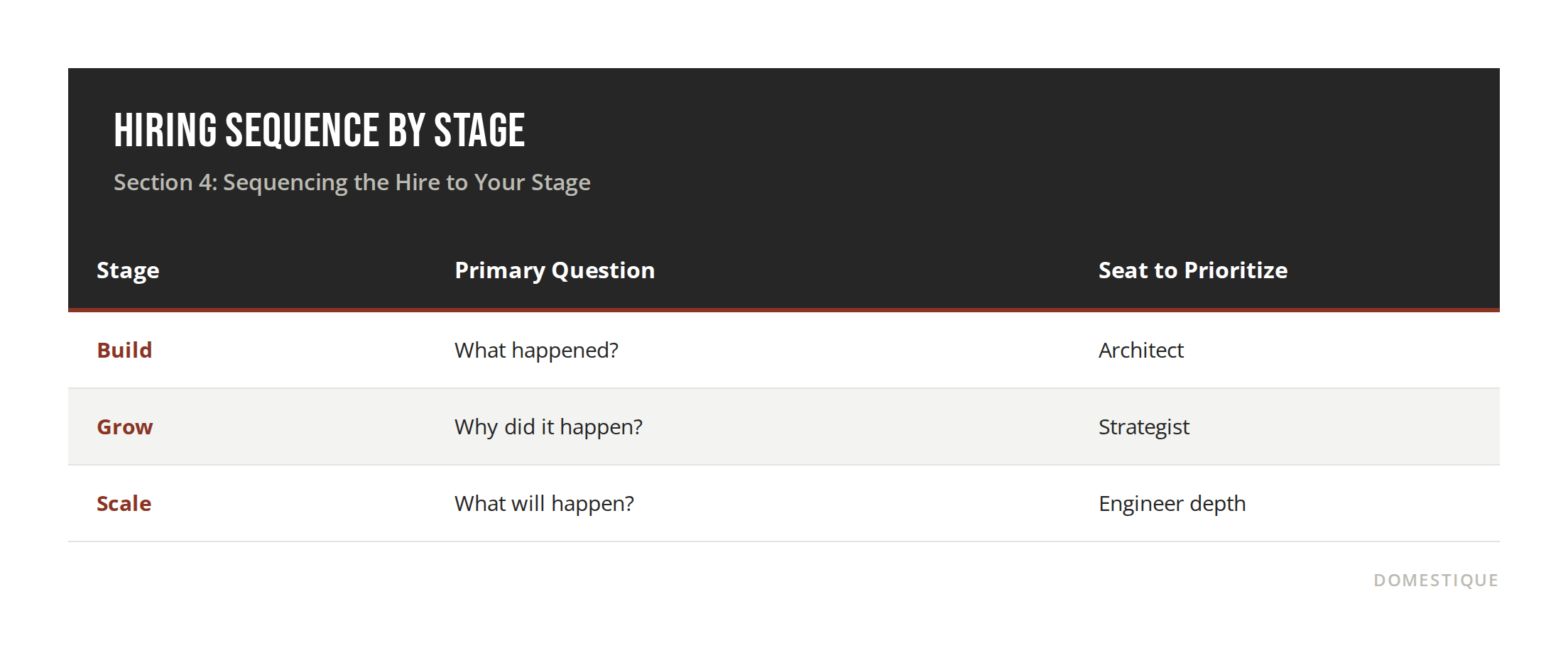
Most teams hire this backwards. They bring in build capacity first because a broken CRM feels urgent, then wonder why the fixes don't hold. The sequence that actually compounds runs the opposite direction.
At the Build stage, the priority is an Architect who can make the funnel predictable and the data trustworthy before anything else gets layered on top. At the Grow stage, a Strategist becomes necessary to keep pipeline consistent as the demand engine matures. At Scale, deeper Engineer capacity pays off because the system it's building on top of was already decided.
Section 5: What the Industry Benchmarks Say
Altitude tells you which seat is unowned. It doesn't tell you how many people you need in total, and that's still worth benchmarking against outside data before you finalize a headcount plan.
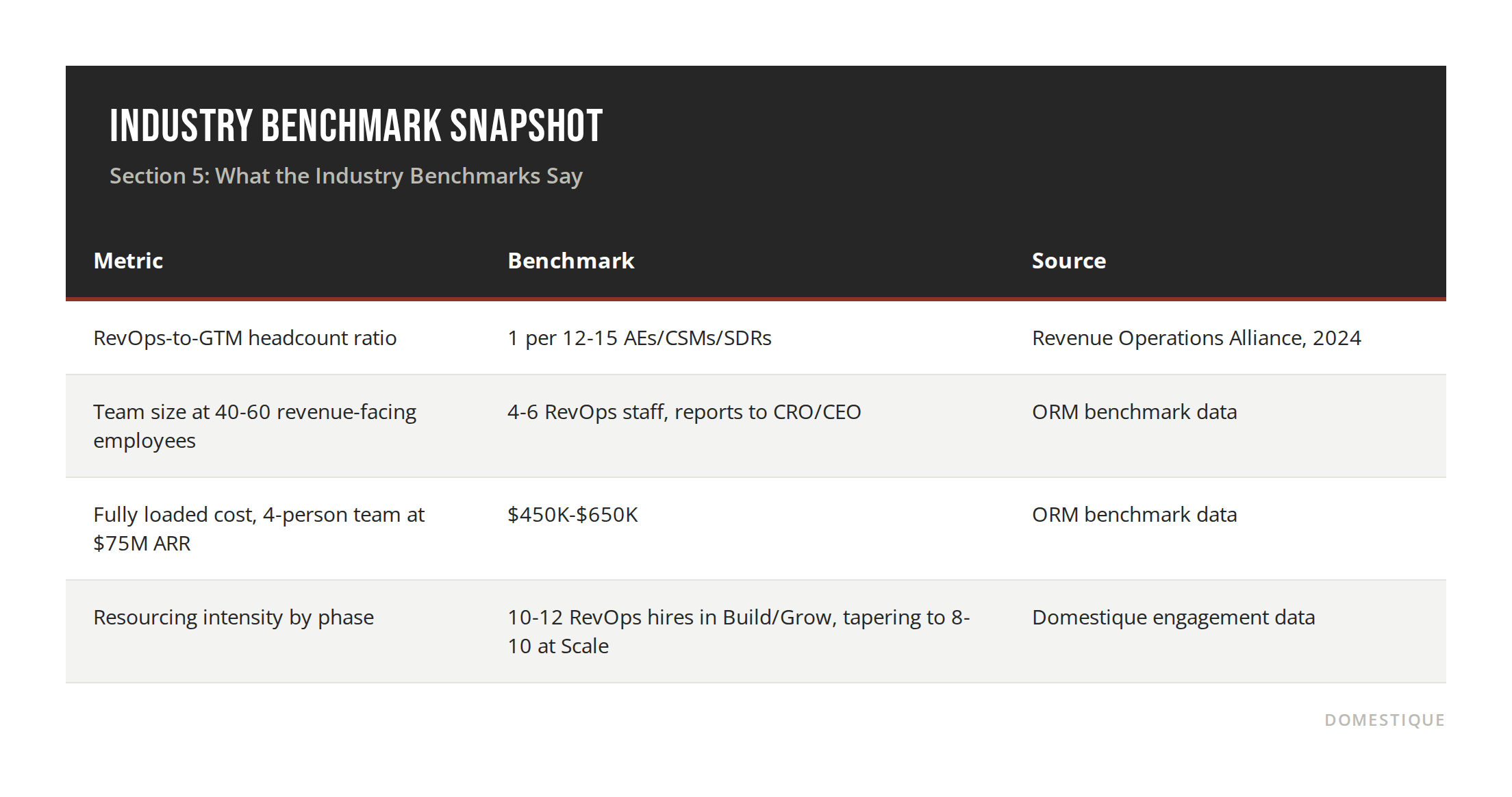
The Revenue Operations Alliance's 2024 State of RevOps survey puts a workable ratio at roughly one RevOps hire for every 12 to 15 combined account executives, customer success managers, and SDRs, a level most teams settle into once the function matures. Company-stage data points in a similar direction: a team of 4 to 6 RevOps staff is typical for an organization with 40 to 60 revenue-facing employees, usually reporting to a CRO or CEO. Cost tends to track headcount directly, with a four-person team at a $75M ARR company running $450,000 to $650,000 fully loaded.
The ratio does scale with company size, but not evenly. A useful range is 10 to 12 RevOps hires during the Build and Grow phases, when the funnel, data model, and process are all still being established. That number typically tapers to roughly 8 to 10 once a company reaches Scale, since the foundation is already in place and the work shifts from establishing systems to maintaining and extending them.
FAQ
Q: What is the difference between sales ops and revenue operations? A: Sales ops covers only the sales team's tools and process. Revenue operations spans sales, marketing, and customer success, and in its current form splits further by decision altitude rather than department.
Q: How many people do you need for a RevOps team? A: It depends more on which altitudes are currently unowned than on headcount alone, but a useful range is 10 to 12 RevOps hires during the Build and Grow phases, tapering to roughly 8 to 10 once a company reaches Scale. That drop reflects less incremental resourcing need per head once the funnel and data model are already established. A five-person team can still be missing the Architect function entirely if everyone scores toward Strategist or Engineer work.
Q: Should RevOps report to sales or to the CEO? A: The Strategist altitude in particular should answer to stated revenue requirements rather than to a single department, since departmental reporting lines tend to bias prioritization toward whichever team RevOps reports through.
Q: What's the first RevOps hire a company should make? A: It depends on stage. Companies at the Build stage benefit most from an Architect who can establish process and data model before tools are chosen, while companies further along often need the Strategist seat filled first.
Conclusion
Revenue operations team structure isn't about counting heads against a revenue benchmark. It's about identifying which of three altitudes, strategist, architect, or engineer, is unowned on your current team, and sequencing the next hire to your operating stage rather than to whichever request is loudest this week. Most teams that feel like they're constantly rebuilding are missing the architect seat specifically, not headcount overall.
If you're not sure which altitude is unowned on your team right now, that's usually the fastest thing to find out before you write another job description.
Watch The Webinar and Score Your Team's RevOps Altitude Coverage
Sources:
Williams, Grady and Williams, Rhys. "The Next Evolution of the Revenue Operator." Domestique webinar, August 13, 2026.
"How to Build the Perfect Revenue Operations Team Structure." Lusha, 2026. https://www.lusha.com/blog/how-to-build-the-perfect-revenue-operations-team-structure/
"Revenue Operations Team Structure: How to Organize RevOps at Every Stage." ORM, March 15, 2026. https://orm-tech.com/blog/revenue-operations-team-structure/
Domestique engagement data, resourcing intensity by growth phase.