RevOps Framework: The Strategy-First Sequence
Most companies build a RevOps framework backward. They start with tooling: a new CRM instance, a lead scoring model, a dashboard nobody asked for. Then they wonder why revenue still feels disconnected across sales, marketing, and customer success.
The problem isn't the tools. It's the sequence. A RevOps framework only works when strategy comes first and process, systems, and reporting follow from it, in that order.
This article lays out the strategy-first sequence we use with B2B SaaS companies, why the order matters more than any individual component, and how to tell if your team is building on the right foundation. Adoption is only accelerating: Gartner projects that a large majority of high-growth companies will be running on a formal RevOps framework by the end of this year [1].
In this article, you will find:
What a RevOps framework actually needs to contain
Why strategy has to precede process, not follow it
How to sequence the four layers without stalling revenue in the meantime
The signs your current framework was built backward
What to prioritize in your first 90 days
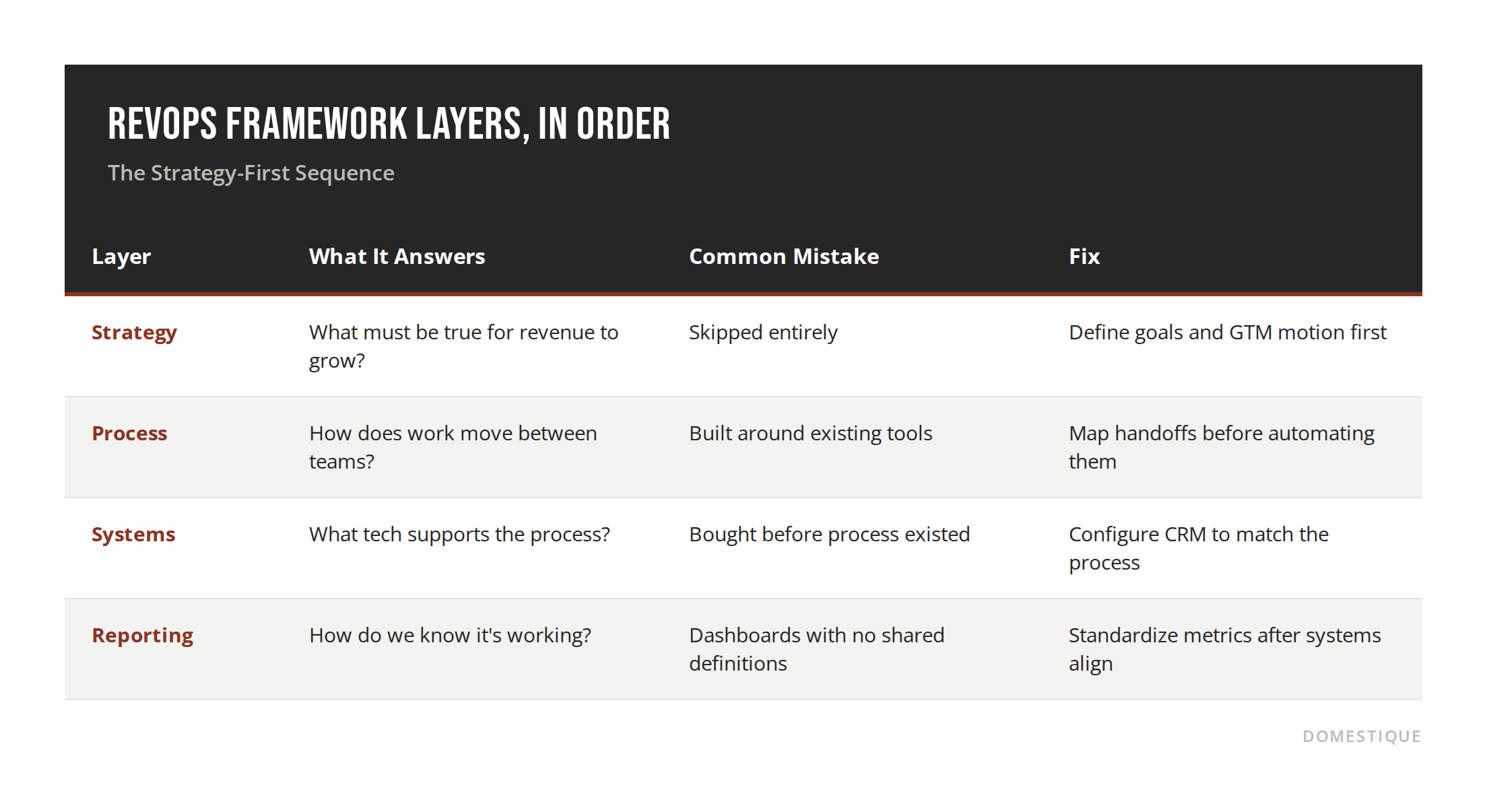
The core takeaway: strategy defines the process, the process defines the systems, and the systems define what you can accurately report. Reverse the order and every layer above compensates for gaps in the layer below it.
Most published frameworks describe RevOps as a set of pillars, commonly people, process, technology, and data, rather than a sequence [2][3]. That framing is useful for auditing maturity, but it doesn't tell you what to build first. Sequencing matters because these pillars depend on each other: a framework that starts with data or technology is really just formalizing whatever ad hoc strategy already existed.
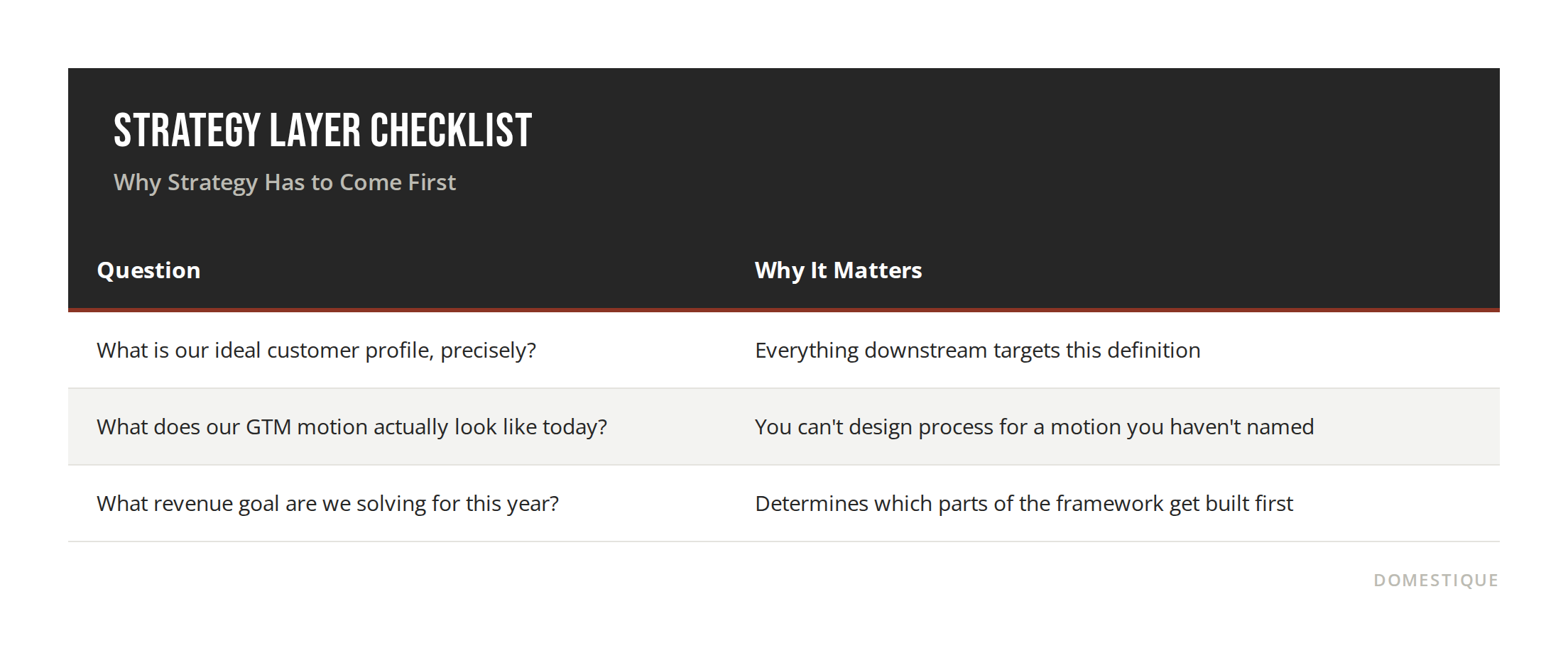
Why Strategy Has to Come First
A RevOps framework isn't a org chart or a tech stack. It's the operating model that connects marketing, sales, and customer success to a shared definition of revenue growth. Without that shared definition, each team optimizes locally. Marketing chases MQL volume, sales chases quota, and customer success chases retention, all using different criteria for what counts as success.
Why Process Should Follow, Not Precede, the Tools
Once strategy is set, process is where most frameworks quietly break. Teams jump straight to configuring HubSpot or Salesforce before anyone has mapped how a lead actually moves from marketing to sales to close. The system then encodes whatever ad hoc process existed before, gaps and all.
Mapping the process first, even on a whiteboard, forces the real question: where does work actually stall? That's usually at handoffs, not within any single team's workflow. Pipeline coverage is a useful example: a common benchmark is roughly three times quota in qualified pipeline, but that ratio only means something once your team agrees on what "qualified" actually means [4].
Systems Should Configure to the Process, Not the Reverse
By the time you reach systems, the decisions should already be made. The CRM's job is to enforce the process you've defined, not to define it for you. This is where most RevOps frameworks either compound their earlier mistakes or start correcting them. A system configured around a clear process becomes a source of truth. A system configured around convenience becomes another data quality problem.
Reporting Only Works When Everything Above It Is Aligned
Reporting is the layer everyone wants first and should build last. A dashboard is only as trustworthy as the definitions feeding it. If sales and marketing don't agree on what a qualified lead is, no amount of dashboard polish will fix the disagreement. Get strategy, process, and systems aligned first, and reporting becomes straightforward instead of political.
FAQ
Q: What is a RevOps framework? A: A RevOps framework is the structured operating model that aligns marketing, sales, and customer success around a shared strategy, connected processes, supporting systems, and consistent reporting.
Q: Why do most RevOps frameworks fail? A: Most fail because teams start with tools or dashboards instead of strategy, which forces every later layer to compensate for decisions that were never made explicitly.
Q: How long does it take to build a RevOps framework? A: A functional strategy-first framework can be scoped in 90 days, though full system and reporting alignment across teams typically takes two to three quarters.
Q: Do we need new software to build a RevOps framework? A: Not necessarily. Most companies already own the tools they need. The gap is usually a missing process layer, not missing software.
Conclusion
A RevOps framework isn't a project you finish once. It's a sequence you protect every time the business changes: new product line, new market, new team structure. Get the order right, strategy first, then process, then systems, then reporting, and the framework holds up under that change instead of breaking every time.
If your current setup feels like it's constantly being patched, the fix probably isn't another tool. It's going back to the strategy layer and rebuilding the sequence correctly from there.
Sources:
Default. "RevOps Framework: What It Is & Why You Need One (+ Examples)." Default Blog, April 28, 2026. https://www.default.com/post/revops-framework
SyncGTM. "The RevOps Framework Every Scaling Company Needs." SyncGTM Blog, March 12, 2026. https://syncgtm.com/blog/revops-framework-guide
PandaDoc. "RevOps Framework: A Guide to Scaling Revenue Operations." PandaDoc Blog, March 14, 2025. https://www.pandadoc.com/blog/revops-framework/
Revenue.io. "15 RevOps Frameworks You Can Steal Today." Revenue Blog, May 8, 2026. https://www.revenue.io/blog/revops-frameworks
Highspot. "The RevOps Frameworks That Drive Growth and Alignment." Highspot Blog, 2026. https://www.highspot.com/blog/revenue-operations-framework/