RevOps Tech Stack: What Actually Belongs In It
Most RevOps teams didn't design their tech stack. They inherited it. A tool gets added for one campaign, another gets added because a rep asked for it, and three years later nobody can say what half the subscriptions actually do. If you've ever tried to map your stack and lost count somewhere past a dozen tools, you're not alone, and you're not the problem. The stack is.
The root cause is almost always the same: tools get bought to solve a symptom instead of a workflow gap, so nobody ever asks what the tool should be replacing. Left unchecked, that pattern compounds every renewal cycle.
This article breaks down what actually belongs in a modern RevOps stack, what to cut, and how to make additions deliberately instead of reactively.
In this article, you will find:
The core layers every RevOps stack needs, and nothing more
A skimmable breakdown of what each layer's job actually is
Why bloated stacks quietly wreck your data before you ever notice
How to decide when a new tool earns a spot in the stack
Answers to the questions teams ask before a stack overhaul
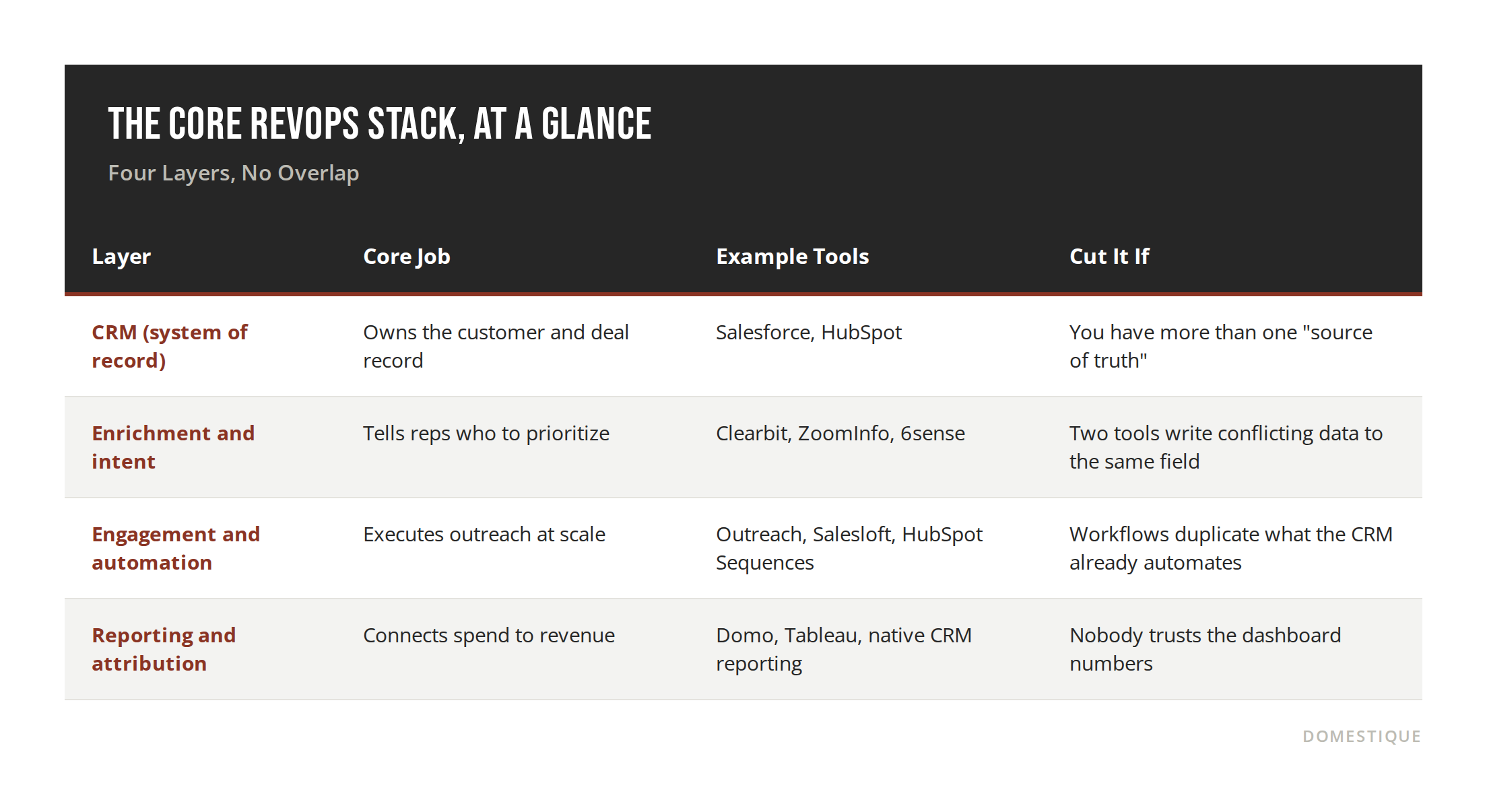
The CRM Is the System of Record, Not the Everything App
The CRM's job is narrow on purpose: it holds the canonical record of who your customers are and where each deal stands. When teams treat it as a catch-all for tasks better handled elsewhere, the record itself gets noisy, and every downstream report inherits that noise.
This is exactly why CRM data quality gets so much attention during a platform change. One widely referenced migration guide points out that before anything moves, a team has to pin down exactly how it uses its current platform, since that use case is what determines which data is actually worth carrying forward. If your team can't answer that question about its current CRM, that's a stack problem, not just a migration problem.
Enrichment and Intent Tools Earn Their Keep or They Go
Enrichment tools exist to answer one question: who should a rep call first. When a stack carries two or three overlapping enrichment subscriptions, the tools start contradicting each other, and reps stop trusting any of them.
Engagement Tools Should Add Consistency, Not Extra Steps
A sales engagement platform is worth its cost when it makes outreach repeatable across a growing team. It's dead weight when it duplicates automation the CRM already handles natively. One detailed migration framework recommends auditing user permissions and rebuilding workflows as a distinct post-transition step, precisely because workflow debt hides in plain sight until someone forces a review.
Reporting Only Works If the Inputs Are Clean
Attribution and reporting tools are the layer everyone wants and the layer that fails first, because they inherit every data quality problem sitting upstream. A well-known migration checklist flags dirty data, duplicates, and inconsistent formatting as the issues that get amplified the moment they move systems. The same logic applies without a migration event: a bloated, ungoverned stack amplifies bad data every single day.
FAQ
Q: How many tools should a RevOps stack actually have? A: There's no universal number. The real test is whether every tool maps to a distinct, non-overlapping job across the CRM, enrichment, engagement, and reporting layers.
Q: How do we know if we've outgrown a tool? A: If it no longer closes a real workflow gap, or duplicates a job another tool already owns, it's a candidate to cut at renewal.
Q: Should we consolidate before or after fixing data quality? A: Fix the data model first. Consolidating a messy stack just moves the mess into fewer places.
Q: What's the biggest sign our stack is bloated? A: Reports different teams no longer trust, or two tools writing conflicting values to the same field.
Conclusion
A RevOps tech stack isn't measured by how many tools it has. It's measured by whether every layer, from the CRM to reporting, has one clear job and no overlap. Teams that treat their stack as a deliberate architecture instead of an accumulation of purchases end up with cleaner data, faster reporting, and fewer surprises at renewal time. The next step is an honest audit of what you already own.
Sources:
Velvetech. "CRM Data Migration Checklist: 10 Steps for a Strategic Move." Velvetech Blog. https://velvetech.com/blog/crm-data-migration-checklist/
Automation Strategists. "A Complete CRM Migration Checklist: Step-by-Step Guide." Automation Strategists Blog. https://automationstrategists.com/blog/crm-migration-checklist/
MigrateToMonday. "The Complete CRM Migration Checklist." MigrateToMonday Resources. https://www.migratetomonday.com/resources/blog/crm-migration-checklist/
Elefante RevOps. "CRM Migration Checklist for Manufacturers: 50 Steps to Zero Downtime." Elefante RevOps Blog. https://elefanterevops.com/blog/crm-migration-checklist-manufacturers
HubSpot. "Understand HubSpot's CRM Migration Process." HubSpot Knowledge Base, updated January 9, 2026. https://knowledge.hubspot.com/integrations/understand-hubspot-s-crm-migration-process