AI in Revenue Operations: Where It Actually Works (and Where It Doesn't)
Every RevOps leader has sat through a pitch promising that AI will fix pipeline visibility, forecasting accuracy, and rep productivity all at once. Some of that is true. A lot of it isn't.
The gap comes from treating AI in revenue operations as one thing. In practice it's a dozen different applications with wildly different maturity levels, and lumping them together is how teams end up disappointed six months into a rollout they were excited about.
This article breaks down where AI for sales operations is already earning its keep, where it's still shaky, and how to tell which category a given use case falls into before you commit budget to it.
In this article, you will find:
A skimmable table of AI RevOps use cases ranked by real-world reliability
Where AI sales operations tools consistently save time and reduce errors
Where AI still needs a human in the loop, and why
What separates teams that get value from AI from teams that don't
A list of data points to pull before you evaluate any AI RevOps tool
Where AI in Revenue Operations Stands Today
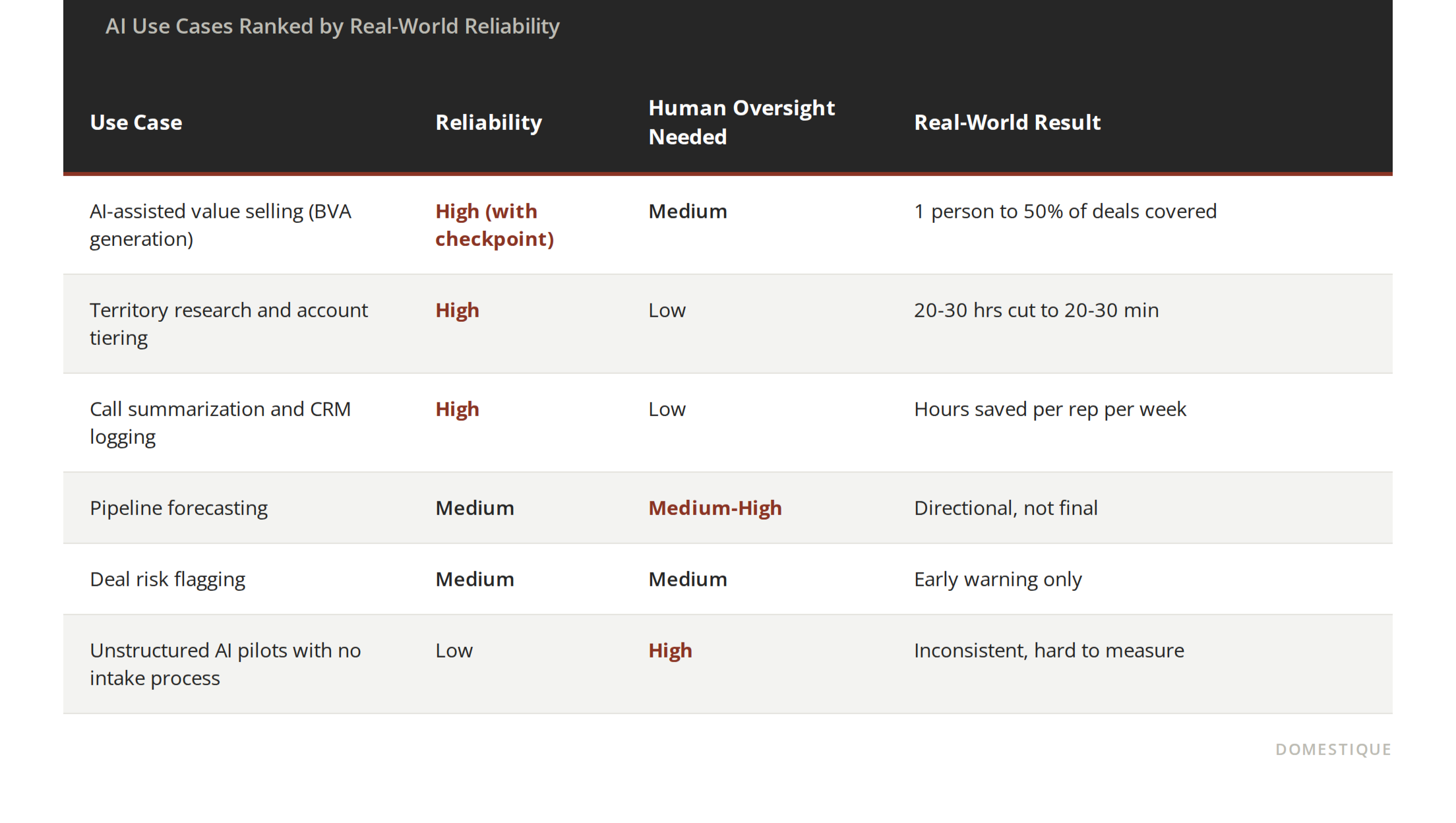
The pattern holds even in mature RevOps stacks. AI performs best on tasks that are repetitive, research-heavy, and structured enough to check against a known framework. It performs worst when there's no baseline to measure against and no process for deciding what "good" looks like before the build starts.
Section 1: Where AI for Sales Operations Is Already Reliable
Take value selling. At one mid-market SaaS company with a full RevOps stack, business value assessments (custom, deal-level ROI decks) were the job of a single Head of Value Engineering. Each one took hours: pulling pain points out of Gong call transcripts, researching the prospect's financials, building a model, and designing the slides. Because it depended on one person, only a handful of the highest-priority deals ever got a BVA at all, which tracks with the broader pattern across B2B: self-serve value tools typically see only about 10% adoption industry-wide.
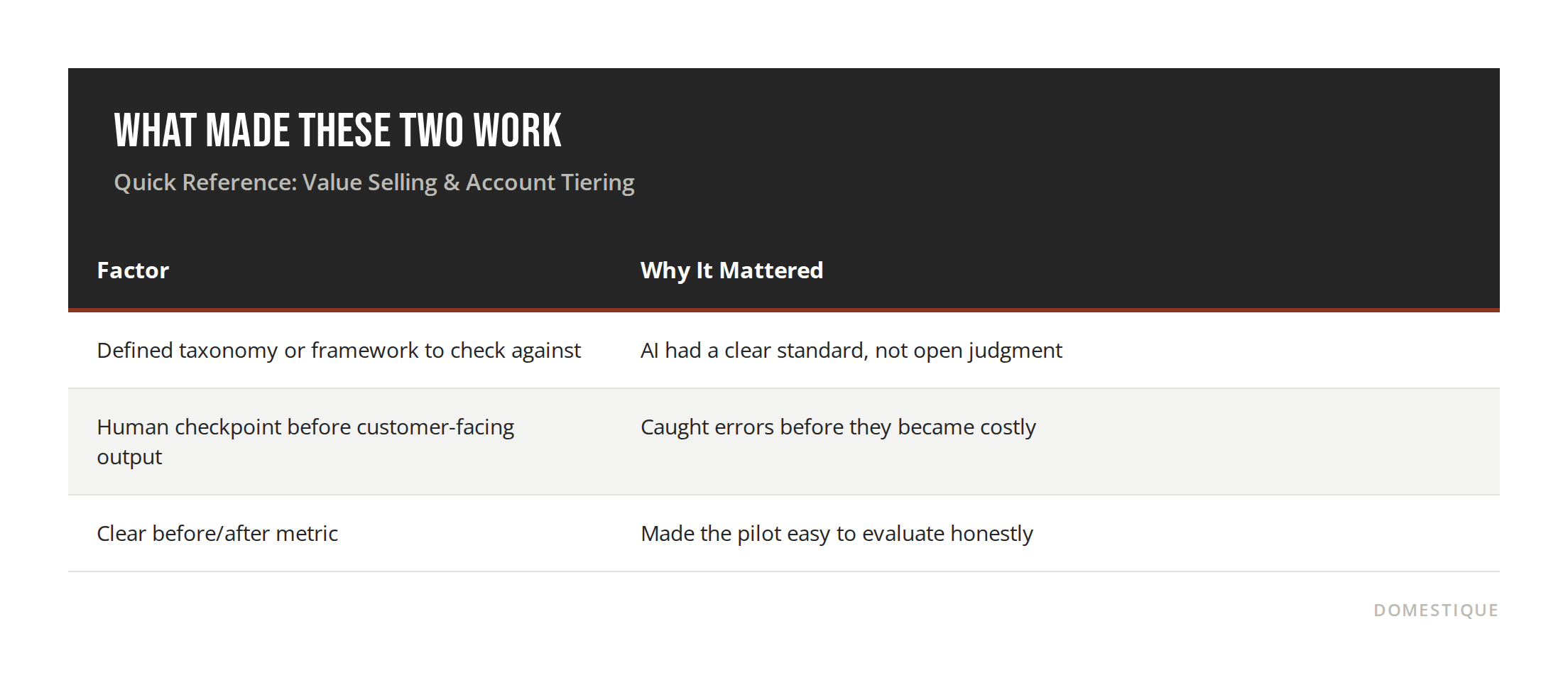
We helped this team scope an AI agent that takes a call transcript, classifies the prospect's top pain areas against a defined taxonomy, researches the company's financials, and populates a first-draft value model and deck, all with a human checkpoint before anything reaches the customer. Target runtime is under five minutes per account. The goal isn't replacing the Head of Value Engineering. It's getting a credible BVA in front of half of all active deals instead of the small fraction one person could ever reach manually.
The same company had a second bottleneck: new rep onboarding. Every new hire inherits roughly 100 accounts and has to manually research each one across the CRM, LinkedIn, and general web search just to figure out which accounts deserve priority. That process ate 20 to 30 hours per rep during onboarding, and the output was inconsistent since newer reps hadn't yet internalized the company's value framework. An AI agent now automates that research and scores each account against the same framework, compressing 20-30 hours into 20-30 minutes and cutting time-to-first-pipeline for new hires from two weeks to one.
Section 2: Where AI in Revenue Operations Breaks Down Without Discipline
Here's the part most teams skip. The same company that built these two agents also stood up a formal AI Center of Excellence with a structured intake process. Every proposed AI initiative has to pass a triage rubric before anyone builds anything: a documented baseline, a defined success metric, and a human-in-the-loop design.
That's not bureaucracy for its own sake. It's the reason the value selling and account tiering projects have a real shot at working while a random, ungoverned AI pilot usually doesn't. Without a baseline, you can't tell if the tool actually helped. Without a success metric agreed on up front, "it feels faster" becomes the whole evaluation. And without a human checkpoint on anything customer-facing, one bad output goes out the door before anyone catches it.
The companies getting real value out of AI in revenue operations generally aren't the ones with the most tools connected to their stack. They're the ones with intake discipline: a rubric, a baseline, and a measurement plan before the first line of a workflow gets built.
FAQ
Q: Is AI in revenue operations actually worth investing in right now? A: Yes, for use cases with a clear framework to check against, like value selling and account tiering, where a human still reviews the output before it reaches a customer. It's a weaker bet for open-ended judgment calls like final forecast numbers or deal strategy.
Q: What's the difference between AI for sales operations and AI in revenue operations? A: AI for sales operations usually refers to tools focused on reps and pipeline, like call intelligence, lead scoring, or value selling assistance. AI in revenue operations is the broader category, spanning marketing, sales, and customer success data and process.
Q: How do we know if our team is ready for AI sales operations tools? A: Start with whether you have a documented framework or taxonomy the AI can check its output against, and a baseline metric to measure improvement. Teams without either tend to get inconsistent results no matter which tool they buy.
Q: Do we need a formal process before building any AI RevOps workflow? A: Some version of one, yes. A lightweight intake rubric covering the problem, the baseline, the success metric, and where a human checkpoint sits is usually enough to keep a pilot from becoming an expensive experiment with no way to judge if it worked.
Q: Will AI replace RevOps roles? A: Not in the near term. In practice it's compressing specific research- and production-heavy tasks, like BVA drafting or account research, which frees up the people in those roles for the judgment calls AI still can't make reliably.
Conclusion
AI in revenue operations isn't one bet, it's a portfolio of smaller bets with different odds. The teams getting real value are the ones pointing AI at tasks with a defined framework to check against, building in a human checkpoint before anything customer-facing goes out, and measuring against a real baseline instead of a feeling. The teams getting frustrated are usually the ones skipping that discipline and hoping the tool figures it out on its own.
If you're trying to figure out where your own RevOps stack stands and what to prioritize next, the RevOps Maturity Checklist is a good starting point. Take the RevOps Maturity Checklist
Sources:
McKinsey and Company. "The State of AI in the Enterprise." 2026.
Gartner. "Forecast: AI Software Revenue Worldwide." 2026.
U.S. Census Bureau. "Business Trends and Outlook Survey (BTOS)." December 2025-May 2026.