

AI-AUGMENTED REVOPS
Your AI Shouldn’t Run on Undefined Rules.
AI in RevOps is an infrastructure decision, not a tooling decision. Domestique builds the business rules layer first, then deploys AI where it actually delivers.
60 Senior Operators • 300+ B2B SaaS Companies • #1 Revenue Operations Company, First Page Sage • HubSpot Platinum Partner • System-Agnostic

THE APPROACH
AI Doesn’t Fix a Broken GTM Engine. It Amplifies One.
Most teams arrive at AI in RevOps the same way: tools purchased, automations deployed, ICs independently using Claude. Six months later, the hours are the same and every output still needs a human to clean it up. (Oh, and you’ve spent tens of thousands of dollars on tokens. Have fun explaining that one to your CFO).
The most common AI failure in B2B SaaS isn’t the model. It’s that nobody wrote the rules down. The prerequisite is a business rules engine: an explicit, agreed definition of what a qualified lead is, when a stage advances, what a closed-won record must contain, and who owns it. AI can’t infer rules your team never agreed on. Point a model at an undefined process and it will produce confidently inconsistent output faster than your team can correct it.
Domestique’s approach is different:
AI-augmented, not AI-dependent. We use AI to move faster and surface more. The judgment and the architecture are still human.
Rules before agents. We won’t deploy automation on top of undefined rules. The infrastructure comes before the agent.
Senior operators on every engagement. The people building your AI workflows have spent their careers building and running GTM systems.
Full GTM coverage. GTM operations across the entire customer journey running on the same AI infrastructure.

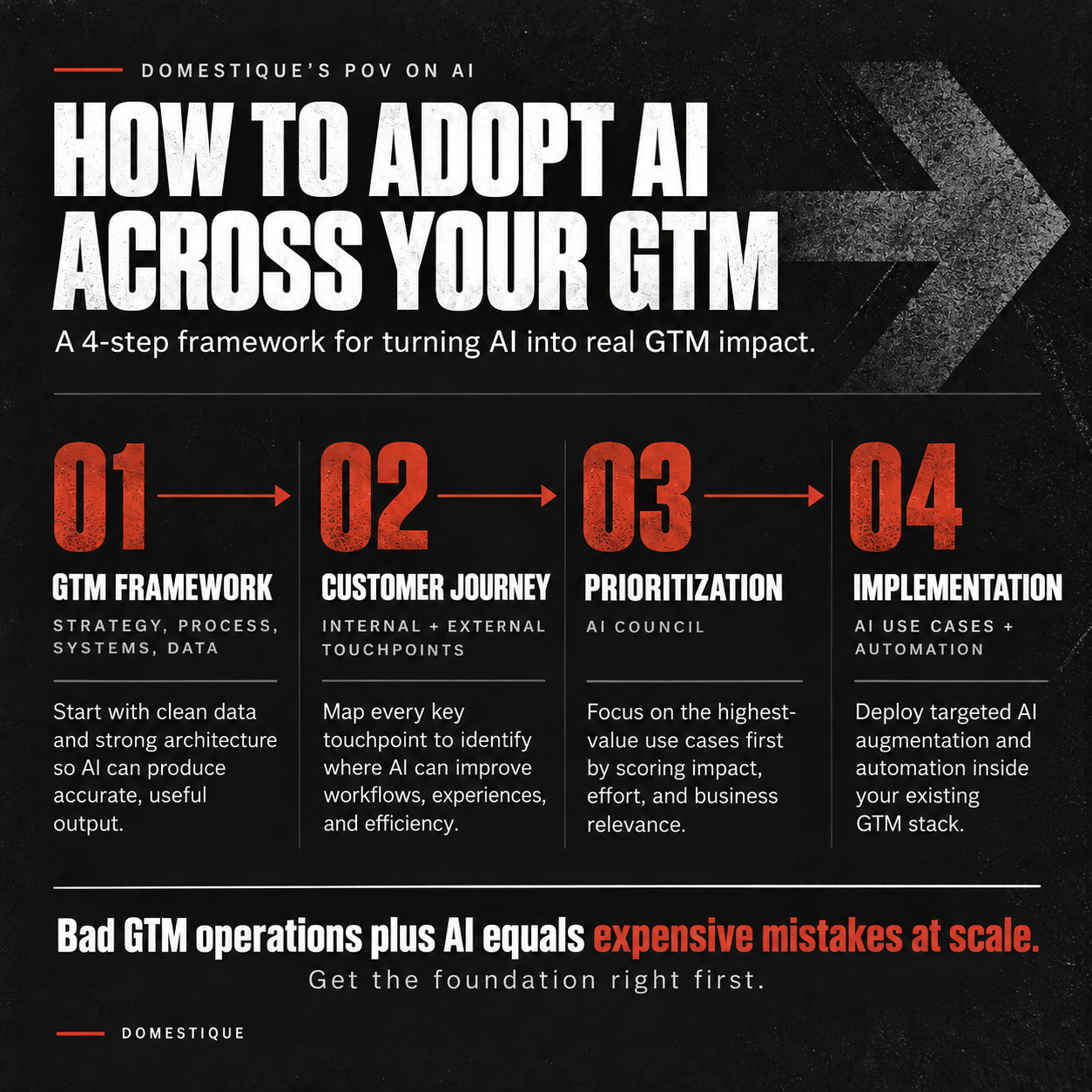
Our POV on AI
THE WORK
What AI in RevOps Actually Looks Like
Agents make the decisions. Automations execute those decisions. Both belong in a GTM engine. They fail for different reasons, and they must be governed differently.
-
01. Agents
AI agents deployed inside your GTM stack: pre-call research that surfaces before a rep picks up the phone, and post-call CRM updates that don’t wait for someone to remember them.
Reliability is the goal here. LLMs are non-deterministic by design, which means hallucination isn’t just a bug you can prompt away. What makes an agent trustworthy is the scaffolding around it: a router that decides what runs, defined tools and MCP connections that constrain what it can touch, and a validator that checks the output before it writes to your CRM. We build that harness; the model is one component within it.
-
02. Automations
Systematic workflows across revenue and marketing operations: attribution models that produce numbers marketing and finance agree on, routing logic that fires on enriched data instead of incomplete form fills, campaign tracking that doesn’t require a manual UTM audit after every launch, and pipeline coverage alerts that fire on a defined threshold instead of a Friday spreadsheet review. Faster, more reliable operations without adding headcount.
-
03. AI-Augmented Audits
The same AI-augmented methodology behind our RevOps, HubSpot, and Salesforce audits: faster discovery, deeper analysis across more of your data than a manual audit can reach, and a senior operator making every call.
-
04. Enablement
Infrastructure nobody adopts is shelfware with better architecture. Every deployment ships with the documentation, training, and governance that determine whether your team still uses it in six months: who owns which agent, what happens when a validator flags something, and how a rep escalates when the output looks wrong.
WHAT CLIENTS SAY


What You'd Ask Before You Sign
-
AI in RevOps is the use of AI agents and automations to run revenue operations work that previously required human attention: research, data hygiene, routing, attribution, and pipeline monitoring. In practice, it’s an infrastructure decision. The AI is only as reliable as the business rules and system architecture beneath it.
-
No, but it changes the sequence. AI deployed on defined business rules and clean processes delivers repeatable results; deployed on undefined rules, it just produces unreliable output faster. If the rules aren’t defined yet, that becomes the first phase of the engagement. A lot of our work starts there.
-
An AI tool solves one problem in one part of your stack, and ChatGPT in a browser tab solves it for one person. What we build is infrastructure: agents and automations wired into your actual systems, running on your actual data and your actual rules.
Our approach is to compose rather than build. Most of what you need already exists in your stack or as a connected service, and the work is wiring it together on rules that hold. The alternative is commissioning a custom platform that your ops team now owns and maintains, which is how RevOps teams end up doing software development by accident.
-
Common starting points: attribution workflows that produce numbers marketing and finance agree on, lead routing that fires on enriched data rather than incomplete form fills, and campaign tracking that doesn’t require a manual UTM audit after every launch.
-
It depends on maturity more than headcount. Build-stage companies get the most value from rules definition and basic automation, because agents on undefined processes just move the mess faster. Grow-stage companies are usually ready for their first agent deployments in research and CRM hygiene. Scale-stage companies are consolidating: replacing overlapping point tools with composed infrastructure and adding governance across what they already run.
-
Both. Some AI work is project-scoped with a defined deliverable. Other deployments are part of a broader fractional engagement. Which makes sense depends on what rules and processes are already in place, and how much of the ongoing operation you want us to own.
Find out where AI fits in your revenue operations.
-
RevOps Audit
Not sure where the break is? Start with a diagnostic.
-
Fractional RevOps
Ready for the full machine? Embedded senior operators, ongoing retainer, full GTM coverage.
-
AI-Augmented RevOps
Agents, automations, and MCP infrastructure built on a deterministic harness.