Salesforce Optimization: Where Most B2B SaaS Teams Get Stuck
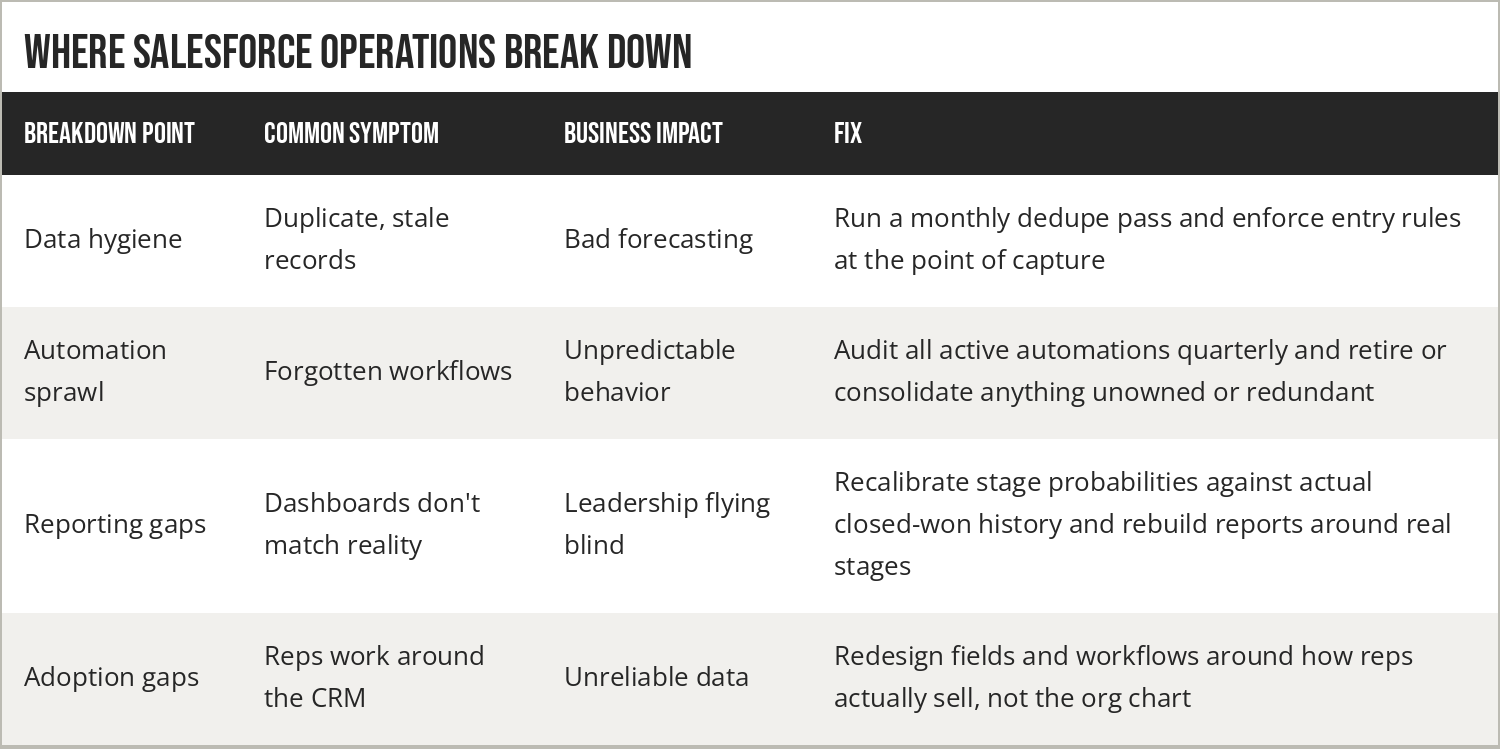
If your reps are building their own spreadsheets because they don't trust the Salesforce numbers, you're not alone. Most B2B SaaS teams don't have a Salesforce problem. They have a maintenance problem: the org was built for the company at 20 people and never rebuilt for the company at 200.
That happens because Salesforce operations and admin work gets treated as a one-time setup instead of an ongoing discipline. Fields get added for one deal, workflows get built for one manager, and three years later nobody can explain why either still exists. Here's where B2B SaaS teams most commonly get stuck, and what to do about it.
In this article, you will find:
Where CRM data quality quietly breaks down
Why workflow and automation sprawl slows teams instead of speeding them up
How reporting gaps hide the real state of the pipeline
Why adoption gaps between design and rep behavior undo good admin work
A practical starting point for fixing all four
Section 1: Data Hygiene Is the Foundation, Not a Cleanup Project
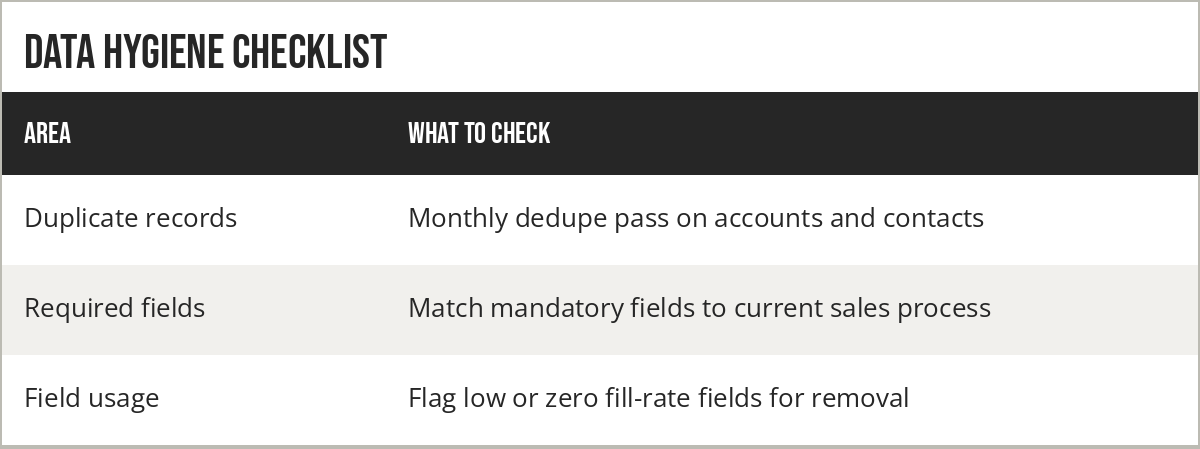
Data hygiene issues rarely show up all at once. They accumulate one manual entry, one bulk import, one abandoned field at a time, until the fix looks like a massive project instead of routine maintenance. It's not a small problem industry-wide either: a recent Validity survey found that 44 percent of companies lose more than 10 percent of annual revenue to bad data.
The teams that stay ahead of this treat data hygiene as an operating rhythm, not an annual event: standardized entry rules enforced at the point of capture, automated dedupe logic, and a clear owner for record quality.
Section 2: Automation Sprawl Slows the Team It Was Built to Help
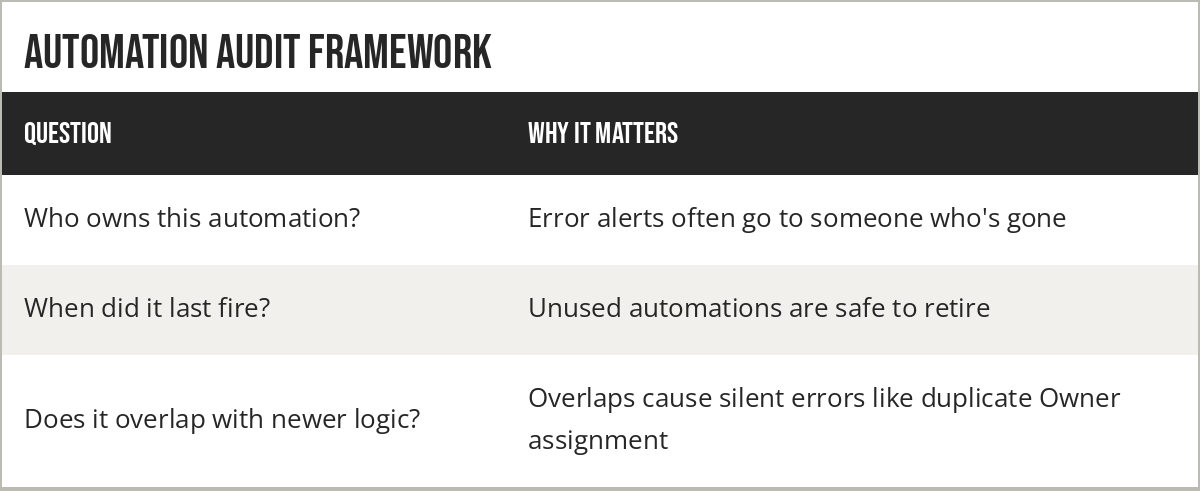
Every workflow, process builder flow, and automation rule adds a little invisible weight to the org. A typical four to six year old org runs 40 to 120 active declarative automations, and an audit usually finds 30 to 50 percent are retirable: a workflow rule and a Flow quietly doing the same job, or logic referencing a field, or an owner, that no longer exists.
The most common failure is invisible by design. Salesforce routes Flow error notifications to whoever last modified the Flow. Once that person leaves the company, the Flow can fail silently for months with nobody on the distribution list to notice. The fix isn't fewer automations; it's fewer nobody understands, kept in check with a regular audit instead of left to accumulate.
Section 3: Reporting Should Reflect the Funnel You Actually Run
A lot of B2B SaaS teams are still reporting on a sales process that changed a year ago. Stages get renamed, new products get added, and the dashboards never catch up.
Most stage probabilities were set once, at implementation, by someone estimating, and never revisited. It's common to find a 15 to 40 point gap between a stage's assigned probability and its actual historical win rate. Proposal or Price Quote often carries 75 percent probability against a real win rate closer to 35 to 45 percent. That's not a slightly optimistic forecast. It's a systematically wrong one, every quarter, in the same direction, because the model it's based on expired years ago.
Recalibrate probabilities against real win rates and enforce clear exit criteria between stages, and rep-level forecast variance of 25 to 35 percent can come down to 10 to 15 percent.
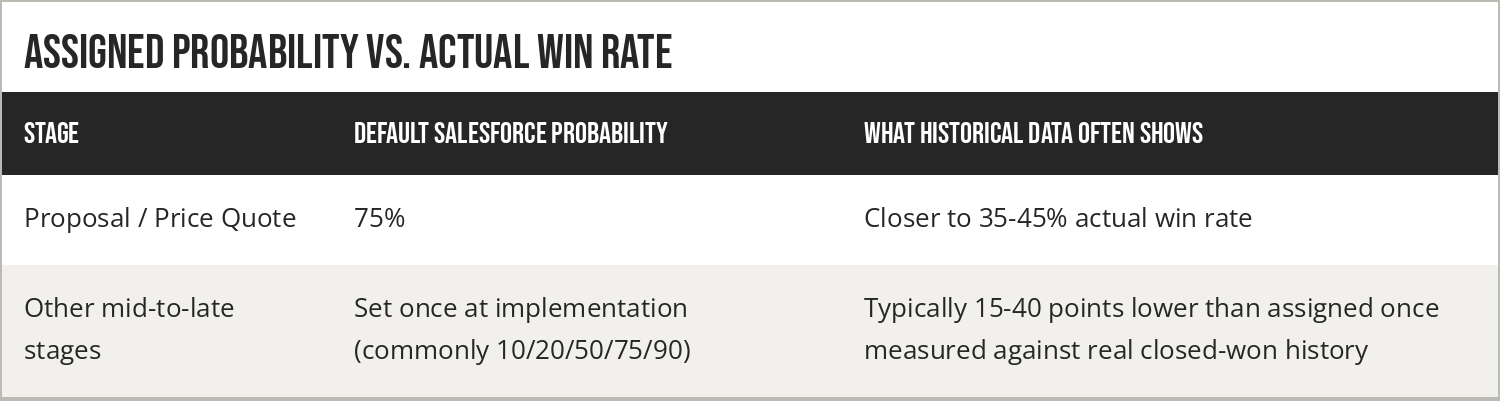
Note: the Proposal/Price Quote figures reflect a pattern we see repeatedly across client orgs. Pulling your own org's Stage History report against closed-won data will show your actual gap.
Section 4: Adoption Follows Design, Not the Other Way Around
Rep adoption is usually blamed on training. More often, it's a design problem. If the CRM asks reps to do more data entry than it gives back in usefulness, they'll work around it, and the data will suffer for everyone downstream. It's a common enough failure that roughly 22 percent of CRM implementations fail due to poor user adoption alone.
Salesforce best practices here are less about enforcement and more about design: build the system around how reps actually sell, and adoption becomes a side effect instead of a battle.
FAQ
Q: How do I know if my Salesforce org needs optimization or just routine cleanup? A: If reps work around the CRM or leadership doesn't trust pipeline numbers, it's beyond routine cleanup.
Q: How often should we audit our Salesforce automations? A: Quarterly as a baseline, with a full audit at least once a year.
Q: What's the difference between Salesforce optimization and administration? A: Administration keeps the system running. Optimization checks whether it still matches how the business sells.
Q: Can we fix adoption without changing the Salesforce build? A: Rarely for long. If design doesn't match rep workflow, problems resurface.
Conclusion
Salesforce operations and admin problems rarely show up as one big failure. They accumulate quietly across data hygiene, automation, reporting, and adoption until the system is harder to trust than to use. Treating Salesforce optimization as an ongoing discipline, not a one-time project, is what keeps that from happening.
If you're not sure where your own org stands, a structured audit is the fastest way to find out.
Sources
Domestique internal Salesforce audit data, aggregated across B2B SaaS client engagements, 2026.
"The CRM Data Quality Crisis of 2026: Solutions That Work." Go-Globe, February 26, 2026. https://www.go-globe.com/the-crm-data-quality-crisis-of-2026-solutions/
"Salesforce Crm Industry: Data Reports 2026." WifiTalents, February 12, 2026. https://wifitalents.com/salesforce-crm-industry-statistics/